
Ever stared at a price tag on a real‑time PCR machine and felt your heart skip a beat? You're not alone—those numbers can look like a wall of code you just can't crack.
I remember the first time our lab tried to upgrade. We had a grant, a tight timeline, and the quote was staring back at us like a silent judge. What we really needed was a way to make sense of the real‑time PCR machine price without pulling our hair out.
So, what does that price actually include? It's not just the chassis; you’re paying for optics, thermal control, software licenses, and often a service contract that keeps the instrument humming for years. For an academic group, that can mean anywhere from $5,000 for a basic entry model up to $30,000 for a high‑throughput system with multiplexing capabilities.
And here's a little secret we’ve learned at Shop Genomics: many researchers overlook the total cost of ownership. Consumables, calibration kits, and even the occasional firmware upgrade can add a few hundred dollars each month. When you add those recurring costs to the upfront price, the real‑time PCR machine price starts to look a lot more realistic—and manageable.
Think about your own workflow. If you’re running dozens of qPCR plates a week, a machine with faster ramp rates might shave hours off your turnaround time, translating into saved labor costs. On the flip side, a smaller benchtop model could be perfect for a teaching lab that only needs occasional runs.
So how do you decide what fits your budget and your science? Start by listing the features you truly need, then match them against price tiers. Ask yourself: Do I need multiplex detection? Do I need integrated data analysis software? Those answers will narrow the field fast.
In the end, the goal isn’t just to find the cheapest tag—it’s to find the machine that lets your experiments shine without breaking the bank. Stick with us, and we’ll walk you through the pricing landscape, from entry‑level options to premium workhorses, so you can make a confident, cost‑smart choice.
TL;DR
Real‑time PCR machine price isn’t just a sticker; it includes the instrument, consumables, service contracts, and hidden monthly costs that can add up fast. Start by listing the features you truly need, compare entry‑level and premium models on Shop Genomics, and calculate total cost of ownership to pick a machine that fits your budget and research goals.
Factors Influencing Real-Time PCR Machine Price
Ever wonder why two labs buying the same brand can see wildly different price tags? It usually comes down to what’s actually inside the box and what you’ll need to keep it humming.
Core hardware vs. add‑ons
The base unit – the thermal cycler itself – sets the floor price. A simple benchtop model might start around $5,000, but once you add high‑resolution optics for multiplex detection, the cost can climb past $30,000. Those optics aren’t just a nice‑to‑have; they let you run several targets in one run, saving reagents and time.
Then there are the optional modules: automated plate loaders, integrated data‑analysis software, or even a built‑in fluorescence reader that supports more dyes. Each of those bumps the price a few thousand dollars, and they’re the reason you’ll see a spread in real-time PCR machine price across vendors.
Throughput and ramp‑rate
If your lab cranks out dozens of plates a day, you’ll want a machine with fast ramp‑rates and a larger block capacity. Faster heating and cooling shave minutes off each cycle, which adds up to hours saved per week. That performance premium can be worth it for a high‑throughput core facility, but a teaching lab might be fine with a slower, cheaper model.
We often see academic groups choosing a mid‑range system that balances speed and cost, while biotech companies opt for the top‑tier units to keep up with tight timelines.
Software licensing and data storage
Most modern qPCR platforms sell the software separately. A basic license might be included, but advanced analytics, cloud backup, or compliance‑ready reporting can cost an extra $1,000‑$3,000 per year. That’s a recurring expense that silently inflates the total cost of ownership.
Speaking of compliance, many labs need to safeguard sensitive genetic data. While we can’t link to a specific cybersecurity guide here (our developer policy blocks external URLs), it’s worth budgeting for data‑security tools if your institution handles patient samples.
Consumables and service contracts
The price of reagents, plates, and calibration kits often dwarfs the upfront hardware cost over time. A typical 96‑well plate run can cost $20‑$30 in consumables alone. Multiply that by hundreds of runs a year, and you’re looking at a few thousand dollars in recurring spend.
Most manufacturers also push service contracts – think annual calibration, on‑site support, and firmware updates. Those contracts can be $2,000‑$5,000 a year, but they keep the machine from breaking down in the middle of a critical experiment.
And here’s a tip we’ve seen work for many labs: compare the total cost of ownership (hardware + software + consumables + service) rather than just the sticker price. That holistic view often reveals a “cheaper” model that’s actually more expensive in the long run.
Choosing the right fit
Start by asking yourself three questions: How many samples will you run each week? Do you need multiplex detection? How important is on‑site support?
Answering those will narrow down the feature set you truly need. Then, browse our collection of real‑time PCR options – for example, the Shop Genomics - Thermal Cyclers page – and match those features to your budget.
Remember, the cheapest tag isn’t always the best investment. A slightly higher upfront price can pay for itself in reduced labor, fewer failed runs, and smoother compliance.
Watching that quick walkthrough can give you a feel for the user interface before you even place an order.
How to Compare Real-Time PCR Machine Prices Across Brands
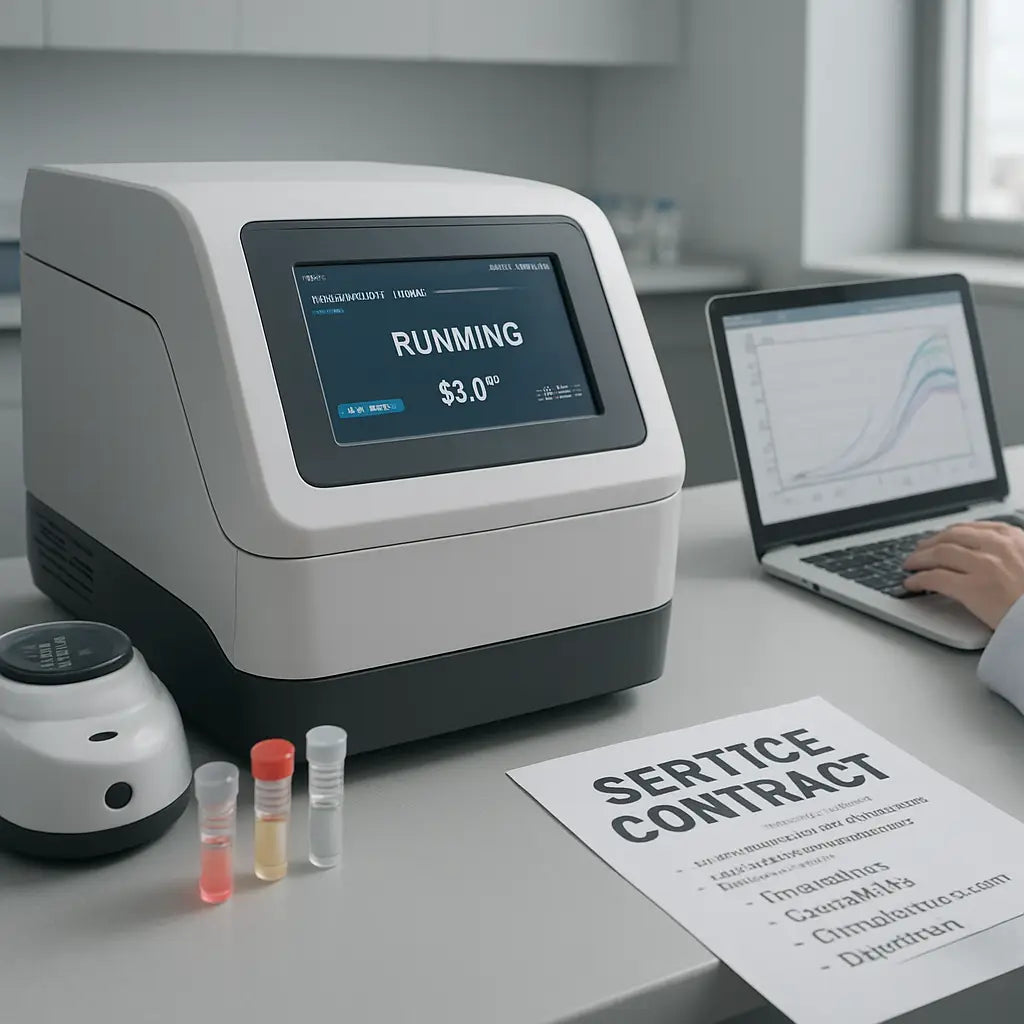
Real-time PCR machine price isn't just a sticker price. It's a package: hardware, optics, software, consumables, service, and sometimes compliance costs. If you're budgeting for an Academic or CRO lab, you'll want a clear method to separate hype from value.
Here's a practical approach we use at Shop Genomics. Start by mapping your actual workflow and then compare apples to apples, not just the lowest quote.
Know your true price drivers
The core hardware matters, yes. A 96-well benchtop vs a 384-well high-throughput system can't be priced the same. The difference isn't just capacity; it's ramp speed, temperature uniformity, and how many targets you can multiplex in one run. Then add software licenses: some bundles include data analysis and cloud storage; others charge annually. Finally, don't forget consumables and calibration or service contracts that keep the instrument running.
Build a side-by-side comparison template
Create a simple worksheet with columns for brand/model, throughput (plates per run), channels (detection), ramp rate (°C/s), software/licensing, annual maintenance, consumables per plate, and five-year total cost. Fill in numbers from quotes you request, and calculate a five-year TCO. If you're unsure about a line item, mark it as a risk factor and revisit with the vendor.
Price components and hidden costs to watch
Hardware price is just the tip of the iceberg. Consumables can add up: a single 96-well plate with multiplex reagents can swing from tens to hundreds of dollars per plate. Software licenses may be annual; budget them as recurring costs. Service contracts vary a lot by vendor and region. If you go without maintenance, a single repair bill could erase years of savings. Also consider regulatory requirements for clinical labs; validation and documentation cost real money.
Real-world scenarios you’ll actually encounter
Scenario 1: An Educational Institution buys a mid-range 96-well unit with essential software and a modest service plan. Five-year cost is balanced by student training needs and predictable consumable use. Scenario 2: A CRO working on viral panels uses a high-throughput 384-well system with multiplexing. The upfront price is steeper, but the per-run cost drops as throughput rises, and the software suite saves time on reporting.
So, what should you do next? Gather three to five formal quotes, demand a five-year TCO, and push for transparent pricing on all components. Does the vendor offer any bundle promotions that include both optics and software? If yes, that can simplify comparisons and reduce surprises later.
Tips and actionable takeaways
Ask for a tested total-cost-of-ownership example from the vendor's existing customers, and request uptime guarantees aligned with your lab's operating hours. Consider financing options or campus-wide equipment purchasing programs to improve cash flow. And remember: at Shop Genomics, we’ve seen models where bundled optics and software deliver a lower five-year cost than you’d expect from separate purchases—a real win for budget-conscious labs.
That’s the gist. Take these steps, run your numbers, and you’ll stop chasing the lowest upfront price and start chasing real value that fits your science.
Video Walkthrough: Evaluating Real-Time PCR Machine Price Options
Ever clicked on a product video and felt a little hope spark that maybe the numbers will finally make sense? That's exactly why we walk you through a quick video checklist – no fluff, just the bits that matter when you stare at the real-time PCR machine price.
First, hit play and pause at the opening shot of the instrument. Ask yourself: does the chassis look sturdy enough for a busy academic lab or a high‑throughput CRO? A flimsy frame might mean more maintenance down the line, which adds hidden costs to the five‑year total.
Step 1 – Spot the optics layout
When the camera zooms into the detection head, count the lasers or LEDs. Two‑channel setups are fine for single‑gene expression work, but if you see three or more, you’re probably looking at a multiplex‑ready model. Multiplex optics add $5,000‑$10,000 to the sticker price, but they can slash per‑run reagent costs dramatically – especially for clinical labs running panels.
And if the video mentions a “software suite” right after, make a note of whether it’s bundled or sold separately. Bundled software often includes cloud storage and automated QC, which otherwise could be a $1,500‑$2,000 annual subscription.
Step 2 – Listen for thermal performance claims
Pay attention to any ramp‑rate numbers the presenter throws out. A fast ramp (say 5 °C/s) can shave an hour or two off a 96‑well run. That sounds nice, but calculate: if you run ten plates a week, that’s 20‑40 hours saved per month. At $30‑$40 an hour for a lab technician, you’re looking at $720‑$1,440 in labor savings every year – a concrete counter‑balance to a higher upfront price.
But don’t just trust the hype. Pause the video, jot down the exact ramp‑rate, then compare it with the spec sheet you’ll request from the vendor. A discrepancy could signal a hidden cost later (like a firmware upgrade to unlock the advertised speed).
Step 3 – Check the service contract teaser
Most walkthroughs will flash a “3‑year warranty” badge. Ask yourself: does the video say anything about on‑site calibration or next‑business‑day repairs? Those details rarely make the headline but can add $2,000‑$4,000 per year if you need them.
And if the presenter mentions a “maintenance plan” with a flat yearly fee, write that down. When you later build your five‑year TCO spreadsheet, treat that fee as a fixed line item – it’s far less scary than an unexpected repair bill that could halt a semester‑long experiment.
Step 4 – Evaluate consumable compatibility
Watch for a quick demo of the plate loading mechanism. Does the machine accept standard 96‑well plates, or does it need proprietary cartridges? Proprietary consumables can add $10‑$20 per plate, which adds up fast in high‑throughput settings.
And if the video shows a “quick‑swap” feature for different block formats, that flexibility might let you future‑proof your purchase – you could start with 96‑well runs and later upgrade to 384‑well without buying a whole new instrument.
Step 5 – Capture the price reveal
When the presenter finally drops the price, don’t stop reading. Immediately note the base price, then list every extra the video mentions – optics upgrade, software license, service plan, optional accessories. Create a simple table in your notes: Base, Optics, Software, Service, Consumables.
Now, do the math. Subtract any bundle discounts you heard about (some vendors offer a 10 % cut when you buy optics + software together). The result is the real “real‑time PCR machine price” you’ll be comparing against other quotes.
Putting it all together – a quick checklist
- Pause at the chassis – assess build quality.
- Count detection channels – match to your assay needs.
- Write down ramp‑rate – translate to labor savings.
- Note warranty length and service details.
- Check plate compatibility – avoid proprietary consumable fees.
- Record every price component shown.
Once you’ve filled this checklist, you’ll have a solid, video‑backed foundation for the five‑year total‑cost‑of‑ownership model you’ll build later. It turns a vague price tag into a clear decision matrix.
So, what should you do next? Grab a notebook, hit play on that vendor video, and run through the steps above. You’ll walk away with confidence that the real‑time PCR machine price you’re eyeing truly aligns with your lab’s workflow, budget, and long‑term goals.
Price Range Table: Entry-Level to High-End Real-Time PCR Machines
When you stare at a quote and wonder if it’s realistic, the first thing to do is line up the basics side‑by‑side. Think of it like a grocery list: you compare apples to apples, not apples to oranges.
Below is a quick snapshot of what you’ll typically see in the market today. Prices are in U.S. dollars, but we’ve also noted the rough equivalent in Indian rupees because many of our CRO partners source equipment globally.
| Tier | Price (USD) | Detection Channels | Plate Format | Best For |
|---|---|---|---|---|
| Entry‑Level | $5,000 – $8,000 | 1–2 | 96‑well | Teaching labs, small academic projects |
| Mid‑Range | $9,000 – $15,000 | 3–4 | 96‑well or 384‑well (optional) | Medium‑size research groups, biotech startups |
| High‑End | $16,000 – $30,000+ | 5–6+ | 384‑well (high‑throughput) | CROs, clinical diagnostics, large pharma |
So, what does that mean for you? If you’re only running a handful of single‑gene assays each week, that $5k‑$8k benchtop will probably cover everything you need. But if you’re juggling multiplex panels or need to crank out dozens of plates a day, the extra channels and faster ramp rates of a high‑end system quickly pay for themselves in labor savings.
Here’s a tip: add the optional optics upgrade cost (usually $5k‑$10k) to the base price before you decide. That way you’re not surprised when the vendor says, “Oh, you’ll need the six‑channel laser for multiplexing.”
And what about service contracts? A three‑year plan often runs $2,000‑$4,000 per year. It sounds like a lot, but compare it to a single on‑site repair bill that can easily top $7,000.
Curious how used equipment fits into this picture? Companies like used real-time PCR systems can shave $3,000‑$8,000 off the sticker price while still delivering reliable performance—perfect for labs on a tight grant budget.
For our friends buying in India, the market shows a similar spread: basic RT‑PCR units start around ₹70,000, mid‑range models sit near ₹1,00,000, and premium multiplex machines can exceed ₹13,00,000 (RT PCR machine price range in India). Converting to dollars, that’s roughly $950, $1,350, and $17,500 respectively—so the relative gaps stay the same.
Let’s watch a short walkthrough that pulls these numbers together and shows the hardware up close. It’s a good way to see what a $12k mid‑range model actually looks like on the bench.
Notice how the video highlights the laser head and the plate loading tray—those are the parts that directly affect your channel count and throughput.
Now, take a minute to copy the table into your own spreadsheet. Add a column for “Annual Service” and another for “Estimated Consumable Cost” based on your plate volume. When you sum everything up over five years, the total cost of ownership usually flattens the gap between a $9k mid‑range and a $20k high‑end unit, especially if the latter saves you 10‑15 hours of technician time each month.
Bottom line: match the tier to your real workflow, not to a glossy brochure. If you’re still on the fence, start with an entry‑level machine, track your run volume for a quarter, and then decide if the upgrade’s ROI justifies the jump.
Tips to Reduce Real-Time PCR Machine Cost Without Compromising Quality
Let’s cut through the noise and talk real. Real-time PCR machine price is real, but you don’t have to choose between budget and reliability. You’re balancing grant timelines, lab throughput, and accurate data—and that’s doable with a smart approach.
First things first: you’ll save more in the long run by focusing on total value, not just upfront sticker price. There are hidden costs that sneak up—consumables, service contracts, software licenses, calibration kits. If you ignore these, your cost per run climbs even if the sticker seems inviting.
So what are the price drivers? Hardware block quality, optical channels, ramp rates, software licensing, consumables per plate, and annual maintenance. Each piece affects how often you’ll run, how quickly you’ll get results, and what your five-year total looks like. Does this really matter for your lab’s workflow? Absolutely—a high emphasis on throughput can pay for itself in saved technician time, even if the upfront price is higher.
Know your true price drivers
Hardware is the foundation. A 96-well block might be affordable, but if your projects demand multiplexing, you’ll need more channels and better optics. Those upgrades can swing price by several thousand dollars. Then there’s software: some bundles include cloud storage and QC tools, others bill annual licenses. Don’t forget consumables and calibration kits—these run costs show up every quarter, not just once a year.
Think about it this way: if your lab runs dozens of plates weekly, a machine with a faster ramp could reclaim hours each month. That labor savings often offsets a higher purchase price over five years. So, what’s your real throughput, and how does that translate to the math?
Build a lean five-year TCO
Create a simple five-year total cost of ownership (TCO) model. List the upfront instrument price, annual software, annual maintenance, and estimated consumables per plate. Then multiply by expected plate volume. The result usually reveals that the cheapest machine isn’t always the best bargain once you account for operating costs.
In our experience, a mid-range unit with sensible maintenance and bundled software often lands as the best value, especially for Educational Institutions and CROs that value reliability and predictable budgeting. Does bundling really matter? Yes—bundles can reduce surprise costs and simplify procurement cycles.
Look for bundled optics and software
Bundled optics and software can dramatically lower the five-year cost of ownership. If a vendor offers an optics upgrade included with software, you often end up with a lower effective per-run cost than buying components separately. And if you’re balancing multiple project streams, consolidated software reduces licensing fatigue and admin time.
In our experience, labs like yours can benefit from shopping around for bundles and asking for transparent line-item pricing. Shop Genomics makes this easier by presenting clear options that align with typical academic and CRO workflows, helping you avoid overpaying for features you won’t use.
Choose workflow-aligned throughput, not prestige
Does your lab need 384-well throughput, or is a solid 96-well system enough for teaching labs and smaller research teams? Matching the instrument to your actual run volume prevents you from paying for capacity you won’t utilize. It also reduces wastage on reagents and calibrators, which quietly drains your budget over time.
What about financing or campus programs? These options can improve cash flow and spread the cost over five years, making a higher-tier unit more accessible without straining annual budgets.
Now you’re closer to a real plan. Start with a realistic run-rate, map out five years, and bring in three to five quotes to compare true costs—not just the headline price. Question every line item, especially maintenance and consumables. Does this look like a cost-effective path for Academic & Research Institutions, CROs, or Clinical labs across 2026 and beyond?
FAQ
What’s actually inside the real-time PCR machine price?
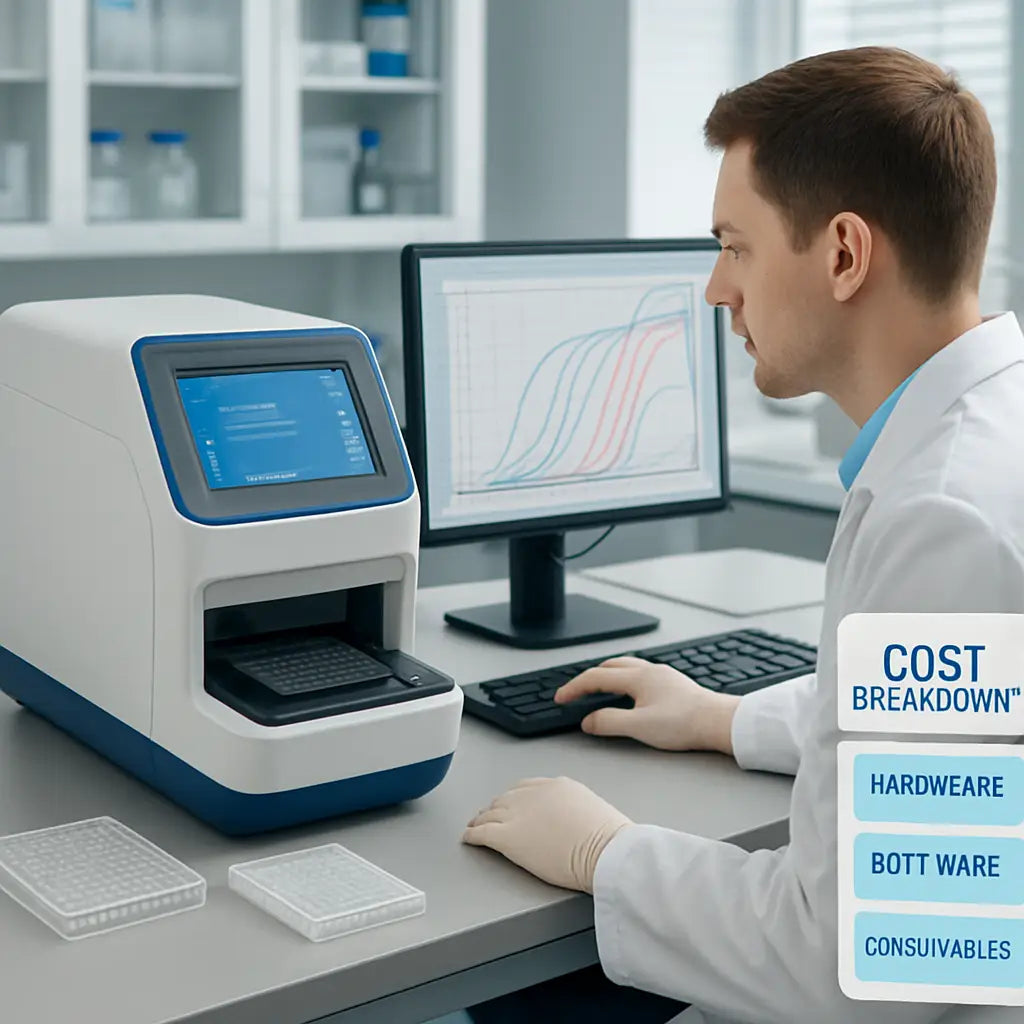
When you see a price tag, it’s not just the metal box. You’re paying for the thermal block, the optics that read fluorescence, the software that turns raw curves into Ct values, and usually a basic service plan. Some vendors bundle extra lasers for multiplexing, or a cloud‑based data portal, which can add a few thousand dollars. In short, the real‑time PCR machine price covers hardware, detection hardware, software licenses, and a starter warranty.
How do I calculate the total cost of ownership for a real‑time PCR machine?
Start by writing down the upfront price, then add recurring items: annual service fees, software subscriptions, and estimated consumable costs per plate. Multiply consumable cost by the number of plates you expect to run each year, and add any calibration kit expenses. Finally, project those numbers over five years and compare that total to your grant budget. This way you see whether a cheaper upfront model might actually cost more in the long run.
Is it worth paying extra for more detection channels?
If your assays need to measure two or three targets at once, extra channels can cut reagent spend dramatically. A six‑channel unit might cost $5‑$10 k more, but multiplex panels can drop per‑plate reagent costs from $150 to $70. For a CRO or a clinical lab that runs hundreds of panels, the savings often outweigh the higher real‑time PCR machine price. For a teaching lab that only runs single‑gene assays, the extra channels are probably overkill.
Can I buy a used or refurbished real‑time PCR machine to lower the price?
Yes, many labs successfully purchase refurbished units that have been calibrated and come with a short warranty. A used system can shave $3‑$8 k off the sticker price, which is a big win for grant‑tight projects. Just make sure the seller provides a service history, and verify that the optics and firmware are up‑to‑date. A quick check of calibration logs will help you avoid hidden repair costs later.
How do service contracts change the real‑time PCR machine price?
Most vendors bundle a one‑year warranty, but a full service contract adds on‑site calibration, firmware upgrades, and next‑business‑day repairs. That usually runs $2‑$4 k per year. Skipping the contract might save money at first, but a single breakdown can stall an entire experiment and cost $7 k or more in emergency repairs. Think of the contract as insurance that smooths out the real‑time PCR machine price over its lifespan.
What financing or lease options are available for labs with tight budgets?
Many manufacturers and distributors offer lease‑to‑own programs that spread the cost over three to five years, often with a low down‑payment. Some universities have campus‑wide purchasing agreements that let you tap into bulk discounts and deferred payment plans. When you compare quotes, ask for the annual cost of the lease and include any required service fees—this lets you see the real‑time PCR machine price as a monthly line item rather than a big upfront hit.
Conclusion
After wading through optics, software licences and service contracts, the real‑time PCR machine price finally feels less like a mystery and more like a choice you can actually control.
Remember that moment when you stared at a $20k quote and wondered if you’d ever afford it? You’re not alone. The key is to match the instrument to the work you actually do, not the hype on the brochure.
Start by listing the assays you run, the plate format you need and whether multiplexing will really save you reagent dollars. Then add the recurring costs – annual service, software subscriptions and consumables – into a five‑year total‑cost‑of‑ownership spreadsheet. You’ll often see a mid‑range model with a modest service plan beat a cheap entry unit that blows up every other year.
So, what’s the next step? Grab a notebook, pull the numbers from the quotes you’ve collected and run the quick TCO checklist we’ve been using all along. If the math still looks shaky, consider a lease‑to‑own option or a bundled optics‑software deal—they can smooth out cash flow without compromising performance.
In short, the real‑time PCR machine price isn’t set in stone; it’s a moving target you can steer with the right data. When you’ve got a clear picture, you’ll walk into the vendor’s office confident you’re getting the best value for your lab’s budget.