

Over three billion base pairs form the complete genetic blueprint of a human, yet making sense of this massive trove remains a major scientific challenge. As researchers race to decode genomic data, the potential for breakthroughs in medicine, agriculture, and environmental studies grows rapidly. Understanding how experts transform raw DNA sequences into practical insights can reveal new paths for innovation and personalized care, making genomic data interpretation more relevant than ever.
Table of Contents
- Defining Genomic Data Interpretation
- Major Types Of Genomic Data And Sources
- Core Methods And Tools For Interpretation
- Common Use Cases Across Scientific Fields
- Pitfalls, Ethical Issues, And Best Practices
Key Takeaways
| Point | Details |
|---|---|
| Comprehensive Analysis | Genomic data interpretation involves analyzing entire genomes using advanced computational methods to derive clinical and biological insights. |
| Diverse Applications | This approach has significant implications across various fields, including personalized medicine, agriculture, and environmental science. |
| Ethical Considerations | Researchers must navigate ethical challenges related to data privacy and informed consent while ensuring responsible data management. |
| Interdisciplinary Collaboration | Effective interpretation requires collaboration among genetics, computer science, and clinical research to advance scientific understanding. |
Defining Genomic Data Interpretation
Genomic data interpretation represents the complex process of analyzing and understanding the vast molecular information encoded within an organism’s genetic material. Unlike traditional genetic testing that focuses on specific gene variations, genomic data interpretation examines comprehensive genetic information across entire genomes, providing unprecedented insights into biological systems and potential health outcomes.
At its core, genomic data interpretation involves translating raw genetic sequences into meaningful scientific and clinical insights. Researchers use sophisticated computational and statistical methods to decode intricate patterns within massive datasets, identifying potential genetic markers, understanding disease predispositions, and uncovering novel biological mechanisms. The process requires advanced bioinformatics techniques, powerful computational algorithms, and interdisciplinary expertise spanning genetics, computer science, statistics, and clinical research.
The significance of genomic data interpretation extends across multiple scientific domains. In medical research, it enables personalized medicine approaches by helping clinicians understand individual genetic risk factors and potential treatment responses. Agricultural scientists use these techniques to develop more resilient crop varieties, while environmental researchers leverage genomic data to study species adaptation and ecosystem dynamics. How Genetic Testing Can Enhance Patient Preventive Care provides additional context on the transformative potential of advanced genetic analysis.
Key components of effective genomic data interpretation include:
- Advanced computational analysis tools
- Statistical modeling techniques
- High-performance computing infrastructure
- Multidisciplinary research collaboration
- Rigorous data validation protocols
By systematically decoding genetic information, researchers can unlock profound insights into complex biological systems, drive scientific innovation, and develop targeted interventions across healthcare, agriculture, and environmental sciences.
Major Types Of Genomic Data And Sources
Genomic data encompasses a diverse range of molecular information that provides insights into genetic structures, variations, and interactions. These data types represent the fundamental building blocks for understanding biological systems, disease mechanisms, and potential therapeutic interventions. Researchers categorize genomic data into several key classifications, each offering unique perspectives on genetic information and its complex implications.
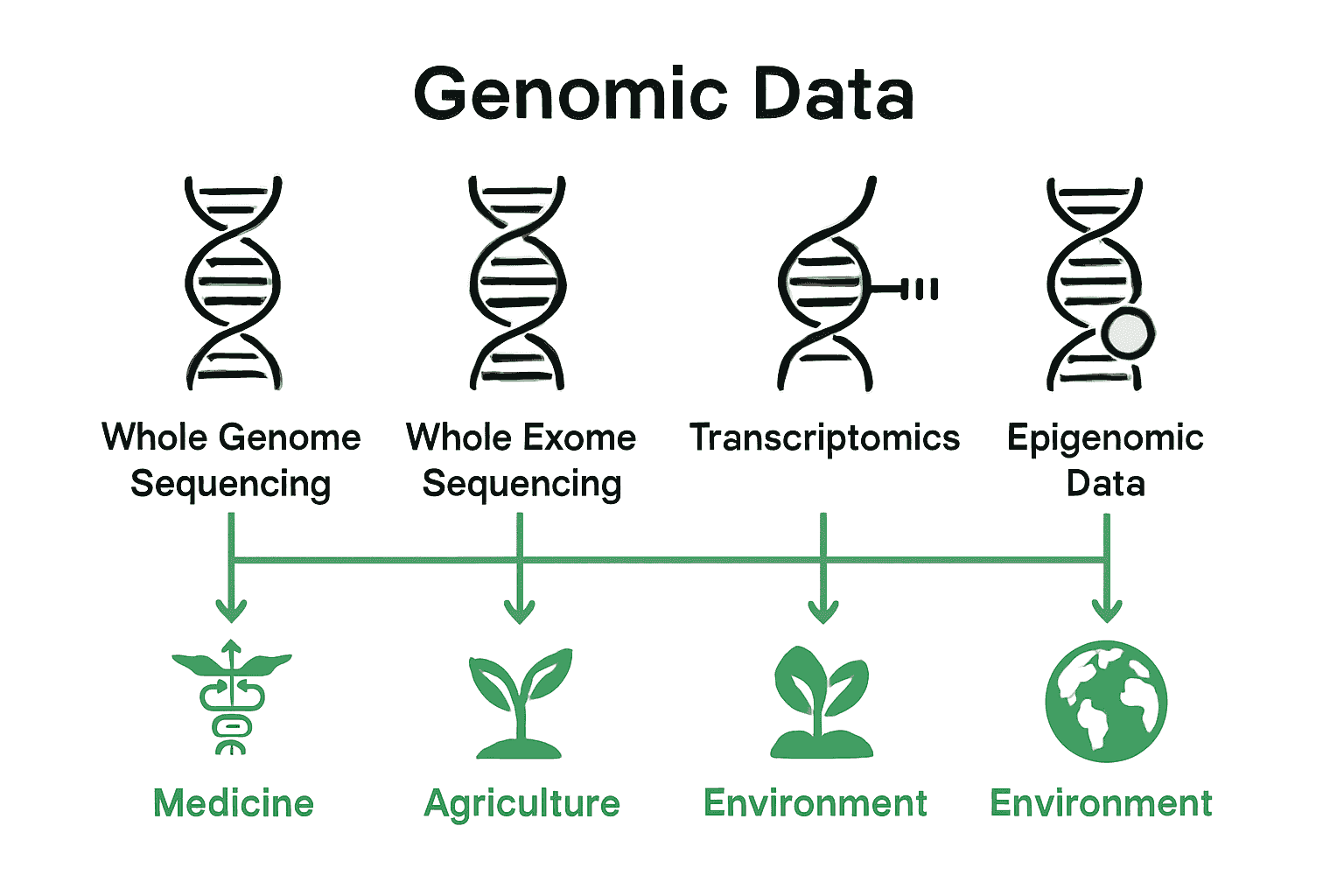
The primary types of genomic data include whole genome sequencing (WGS), whole exome sequencing (WES), transcriptomics, and epigenomic data. Whole genome sequencing captures the complete DNA sequence of an organism, providing comprehensive genetic information. Whole exome sequencing focuses specifically on protein-coding regions, offering a more targeted approach for identifying genetic variations. Transcriptomics examines gene expression levels, revealing how genetic information is transformed into functional RNA and protein molecules. How to Choose the Right Genetic Test for Your Study can help researchers select the most appropriate genomic analysis technique for their specific research objectives.
Research projects like The Cancer Genome Atlas (TCGA) and the 100,000 Genomes Project have been instrumental in creating extensive genomic data repositories. These initiatives collect and curate genomic information from diverse populations, enabling researchers to:
- Investigate genetic variations across different diseases
- Develop personalized medical interventions
- Understand complex genetic interactions
- Create comprehensive genetic reference databases
- Support advanced medical research and diagnostic techniques
Genomic data sources range from large-scale international research programs to individual research laboratories, clinical settings, and specialized genomic research centers. Each source contributes unique datasets that collectively advance our understanding of genetic complexity, disease mechanisms, and potential therapeutic strategies across multiple scientific disciplines.

Core Methods And Tools For Interpretation
Genomic data interpretation relies on a sophisticated ecosystem of computational methods and advanced bioinformatics tools that transform raw genetic information into meaningful scientific insights. These tools enable researchers to navigate the complex landscape of genomic data, decoding intricate molecular patterns and uncovering critical biological relationships that drive scientific understanding.
The core methods for genomic data interpretation encompass several key approaches, including sequence alignment, variant calling, genome annotation, and pathway analysis. Sequence alignment algorithms compare genetic sequences to identify similarities and variations, while variant calling techniques detect genetic mutations and polymorphisms. Genome annotation tools map functional elements within DNA sequences, helping researchers understand gene locations, regulatory regions, and potential genetic markers. Unlock Your Genetic Secrets with Genome Sequencing at Shop Genomics provides additional insights into the technological advances driving these interpretative methodologies.
Researchers utilize a range of specialized computational tools to facilitate genomic analysis, including:
- Genome browsers (e.g., UCSC Genome Browser, Ensembl)
- Sequence alignment software (Bowtie, BWA)
- Variant analysis platforms (GATK, FreeBayes)
- Statistical analysis packages (R, Python-based tools)
- Machine learning algorithms for predictive modeling
- High-performance computing infrastructure
Advanced computational techniques like machine learning and artificial intelligence are increasingly transforming genomic data interpretation, enabling more sophisticated analysis of complex genetic datasets. These innovative approaches allow researchers to identify subtle genetic patterns, predict disease risks, and develop personalized medical interventions with unprecedented precision and depth.
Common Use Cases Across Scientific Fields
Genomic data interpretation serves as a transformative tool across multiple scientific disciplines, enabling researchers to unlock complex biological insights and drive innovative discoveries. From medicine to environmental science, genomic analysis provides unprecedented opportunities to understand intricate molecular mechanisms and develop targeted solutions to complex challenges.
In medical research, genomic data interpretation plays a critical role in personalized medicine, disease diagnosis, and treatment development. Researchers use genomic insights to identify genetic risk factors, predict disease susceptibility, and design targeted therapeutic interventions. Clinical applications range from cancer research and rare genetic disorder identification to pharmacogenomics, where genetic variations inform precise medication strategies. Best 7 Laboratory Equipment for Universities highlights the technological infrastructure supporting these advanced research methodologies.
Beyond healthcare, genomic data interpretation extends its impact across diverse scientific domains:
- Agricultural science: Developing crop resilience and genetic improvement
- Environmental research: Studying species adaptation and ecosystem dynamics
- Evolutionary biology: Tracking genetic mutations and population migrations
- Forensic science: Analyzing genetic evidence and establishing biological relationships
- Anthropology: Understanding human migration patterns and genetic diversity
The interdisciplinary nature of genomic data interpretation demonstrates its profound potential to generate insights that transcend traditional scientific boundaries. By integrating advanced computational techniques with biological understanding, researchers can address complex questions, develop innovative solutions, and push the frontiers of scientific knowledge across multiple disciplines.
Pitfalls, Ethical Issues, And Best Practices
Genomic data interpretation involves navigating a complex landscape of technical challenges and profound ethical considerations. The immense power of genetic research brings with it significant responsibilities, requiring researchers and institutions to develop robust frameworks that balance scientific progress with individual privacy, consent, and potential societal implications.
Key ethical challenges in genomic research center around data privacy, informed consent, and potential discrimination. Genetic information represents the most personal form of biological data, carrying implications that extend beyond individual subjects to entire family networks and populations. Researchers must implement stringent data protection protocols, ensuring participant anonymity and preventing unauthorized access or misuse of sensitive genetic information.
 STEM Grant Opportunities for Classroom Lab Supplies underscores the importance of responsible research practices in scientific education and development.
Best practices for ethical genomic data interpretation include:
- Obtaining comprehensive, transparent informed consent
- Implementing robust data anonymization techniques
- Establishing clear data sharing and usage guidelines
- Creating independent ethics review committees
- Developing secure computational infrastructure
- Providing participants with options for data withdrawal
- Maintaining ongoing communication about research objectives
Researchers must also address potential biases in genomic data collection and interpretation, recognizing that historical underrepresentation can lead to skewed scientific understanding. Developing inclusive research methodologies, ensuring diverse participant populations, and maintaining transparency about research limitations are crucial steps in creating responsible, equitable genomic research practices that serve broader scientific and societal interests.
Empower Your Genomic Data Interpretation with Cutting-Edge Tools
Understanding genomic data interpretation can feel overwhelming due to the complexities of big data analysis, variant calling, and ethical challenges. Researchers face the constant pressure to access reliable, high-performance equipment and advanced computational resources to unlock critical genetic insights effectively. If you are striving to transform raw genetic sequences into meaningful discoveries, Shop Genomics is here to help you overcome these hurdles.
Explore our wide range of affordable, state-of-the-art genomic research equipment designed to integrate seamlessly into your workflow. Whether you need sequencing tools, bioinformatics software support, or laboratory essentials, our solutions are built to accelerate your research and enable precise genomic interpretation. Don’t let financial barriers slow your progress – visit Shop Genomics today to discover how to elevate your capabilities and advance your scientific goals with confidence.
Frequently Asked Questions
What is genomic data interpretation?
Genomic data interpretation is the process of analyzing and understanding the vast molecular information encoded within an organism’s genetic material. It involves translating raw genetic sequences into meaningful scientific and clinical insights using advanced computational and statistical methods.
What are the major types of genomic data used in research?
The major types of genomic data include whole genome sequencing (WGS), whole exome sequencing (WES), transcriptomics, and epigenomic data. Each type provides unique insights into genetic structures, variations, and interactions relevant to biological systems and disease mechanisms.
How do researchers interpret genomic data?
Researchers interpret genomic data by employing core methods such as sequence alignment, variant calling, genome annotation, and pathway analysis, often using specialized computational tools and statistical analysis packages to transform raw genetic information into meaningful insights.
What ethical considerations must be addressed in genomic data interpretation?
Key ethical considerations include data privacy, informed consent, and preventing discrimination based on genetic information. Researchers must implement robust data protection protocols and ensure transparency throughout the research process to address these challenges.