

Ever stared at a bench full of glass cuvettes and wondered if you’re really getting the best read on your samples?
That moment of doubt is what pushes many labs to ask: microplate reader vs spectrophotometer – which one actually saves time and money?
In a nutshell, a spectrophotometer shines a single beam of light through one cuvette at a time, measuring absorbance or transmittance. It’s the classic tool you learned about in undergrad chemistry, great for precise, low‑throughput work.
A microplate reader, on the other hand, spreads that same principle across 96, 384 or even 1536 wells. Imagine swapping a single‑cup coffee maker for a drip machine that brews dozens of cups at once – the speed boost is huge.
So why does the choice matter for you? If you’re running a handful of DNA extractions in a teaching lab, the single‑tube spectrophotometer might feel familiar and inexpensive. But if you’re a biotech startup scaling enzyme kinetics or a CRO processing dozens of assay plates daily, the plate reader’s ability to handle many samples in parallel can cut hands‑on time by half.
And there’s more than just speed. Modern microplate readers often bundle fluorescence, luminescence and absorbance modes, letting you switch assays without buying a new instrument. Spectrophotometers usually stick to absorbance, so you might need extra gadgets for other readouts.
That said, cost is still a real factor. A basic spectrophotometer can sit under $2,000, while a decent plate reader often starts a few thousand dollars higher. Yet the long‑term savings from reduced labor and consumables can quickly outweigh the upfront gap.
We’ve seen labs in academic research and clinical diagnostics make the switch after realizing they were bottlenecked by the slow, one‑sample‑at‑a‑time workflow. The result? Faster data, more replicates, and a smoother path to publication or regulatory submission.
If you’re still on the fence, ask yourself: how many samples do I truly need to read each day, and how much bench time am I willing to trade for precision?
Let’s dive deeper into the key differences, so you can decide which instrument fits your workflow best.
TL;DR
Choosing between a microplate reader and a spectrophotometer boils down to throughput needs, assay versatility, and budget constraints for your lab.
If you run dozens of plates daily, a microplate reader saves time and reagents, while occasional low‑sample work may still favor a simple, affordable spectrophotometer in your specific workflow.
What Is a Microplate Reader?
When you hear “microplate reader” for the first time, it can feel like another piece of jargon tossed onto an already crowded bench.
In simple terms, a microplate reader is a device that shines light—whether UV, visible, fluorescence, or luminescence—through each well of a 96‑, 384‑ or even 1536‑well plate and records the intensity that comes back. Think of it as a super‑charged spectrophotometer that can multitask across dozens of tiny test tubes at once.
But why does that matter for you? If you’re running a gene‑expression assay with hundreds of samples, swapping a single cuvette for a whole plate slashes hands‑on time, cuts reagent waste, and gives you data that’s easier to compare side‑by‑side.
Core components you’ll see
Every reader has three basic parts: a light source (often LEDs or a xenon lamp), a detector (photodiode or photomultiplier), and a motorised plate holder that moves each well into the light path. Some high‑end models even add a cuvette port so you can flip between plate and traditional cuvette measurements without changing instruments.
Modern readers also bundle software that lets you set up kinetic runs, temperature control, and multiplexed fluorescence‑luminance assays—all from the same screen.
How it differs from a classic spectrophotometer
A traditional spectrophotometer measures one sample at a time, pulling a single beam through a cuvette. It’s precise, but it’s also slow when you have more than a handful of samples. A microplate reader, on the other hand, treats each well as its own mini‑cuvette, cycling through them in seconds. That speed is the key advantage in high‑throughput workflows.
And here’s a practical tip: many labs pair a plate reader with a barcode‑label printer to keep track of which sample sits in which well. If you need a reliable source for those labels, custom lab label printing services can save you time and avoid mix‑ups.
When you watch a product demo on YouTube, you might spend ten minutes just scanning the video for the part that explains the fluorescence mode. That’s where a tool like YTSummarizer can help—paste the link, get a quick summary, and decide if the reader fits your assay needs without watching the whole clip.
Our own experience at Shop Genomics shows that researchers who start with a basic UV‑Vis plate reader often upgrade to a multimode system once they add luminescence‑based drug‑screening assays. You can explore the range of options in our Nano Spectrophotometers & Fluorometers collection, which includes models that combine absorbance, fluorescence, and even a cuvette port.
Below is a quick video that walks through the basic workflow—from loading the plate to interpreting the readout. It’s a good visual complement to the text.
After you’ve seen the demo, picture the plate sitting on a refrigerated deck, the software automatically flagging wells that fall outside your control limits, and the data exporting straight to your analysis pipeline. That’s the kind of seamless integration that turns raw absorbance numbers into actionable biology.
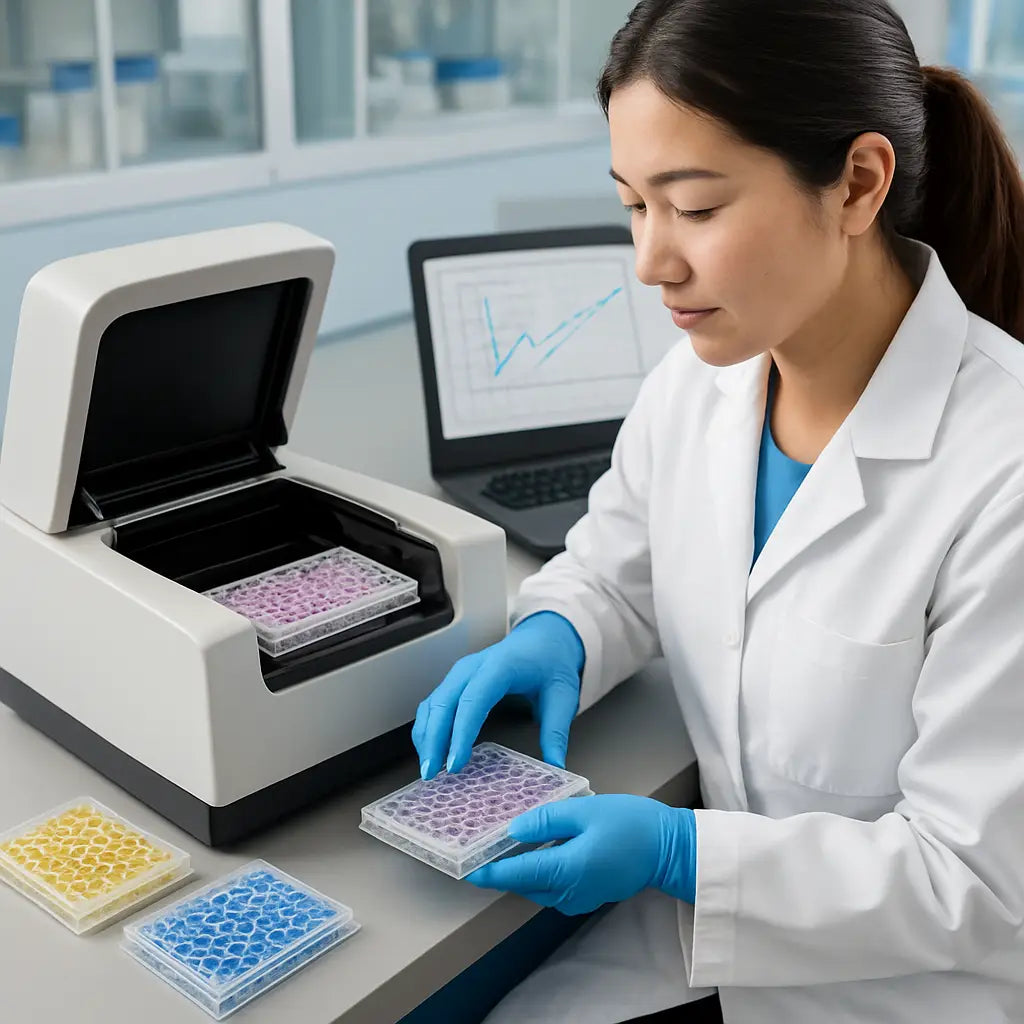
In short, a microplate reader is your go‑to for scaling up assays, cutting down repeat measurements, and keeping your data consistent across dozens of samples. Whether you’re an academic lab, a CRO, or a biotech startup, understanding how the reader works—and how it pairs with good labeling and quick video summaries—will let you choose the right instrument for the job.
What Is a Spectrophotometer?
Imagine you have a single cuvette, a tiny glass tube, and you shine a beam of light through it. A spectrophotometer reads how much of that light gets absorbed or transmitted, turning the result into an absorbance number you can trust.
A classic spectrophotometer has four key parts: a light source, a monochromator or filter to pick a wavelength, a cuvette holder that defines a 1‑cm path length, and a detector that converts the exiting light into a digital signal.
Most models cover the UV‑Vis range (roughly 185–700 nm), while some extend into the infrared (up to 150 µm), letting you tackle everything from protein quantification to water‑quality testing.
The cuvette’s fixed path length means the light travels the same distance every time, which is why spectrophotometers are prized for high‑precision, low‑throughput work. You’ll often see them in chemistry labs, clinical diagnostics, and environmental monitoring.
For a quick overview of the tech, New Life Scientific breaks down the core components and why the cuvette design gives you that extra accuracy — perfect reading for single‑sample assays.
Here’s a short video that walks you through the basic workflow of a bench‑top spectrophotometer.
When you first fire it up, let the instrument run its warm‑up routine, then run a blank cuvette with just solvent. That baseline correction wipes out stray light and gives you a clean start.
Because the beam travels a fixed 1 cm path, you can calculate concentration directly from Beer‑Lambert’s law (A = ε · c · l). Just plug in the molar absorptivity, your measured absorbance, and the path length, and the math does the rest.
In a clinical lab, you might use a spectrophotometer to quantify hemoglobin or measure enzyme activity in a 1‑mL cuvette. In environmental testing, the same instrument can determine nitrate levels in water samples, keeping regulatory filings on track.
Looking for a rugged model that’s trusted in water‑quality labs, the Hach DR‑3900 offers built‑in RFID and automated data logging, which cuts down on manual entry errors and speeds up compliance reporting.
Bottom line: a spectrophotometer gives you pinpoint accuracy for single samples, but you’ll need consistent cuvette handling and regular calibration to keep that precision alive.
Key things to check before you run a sample
First, verify the cuvette is clean and fingerprint‑free – a quick rinse with distilled water and a lint‑free wipe does it. Second, set the wavelength to your assay’s absorbance peak; double‑check the method sheet. Third, run a fresh blank whenever you change reagents; even a tiny solvent shift can move the baseline. Finally, note the temperature; a 2 °C change can shift absorbance by up to 5 %.
Whether you’re a university researcher, a CRO analyst, or a clinical lab tech, understanding how the light‑path works lets you choose the right tool for the job and get data you can rely on.
Key Performance Differences
When you compare a microplate reader vs spectrophotometer, the first thing you’ll notice is how they handle data speed.
Throughput and turnaround time
A microplate reader can scan a 96‑well plate in a few seconds, giving you 96 results while you’re still sipping coffee.
A spectrophotometer reads one cuvette at a time, so you’ll spend minutes on the same number of samples.
If your lab processes dozens of plates daily – think CROs or biotech startups – the reader saves you hours of bench time.
That speed difference really adds up when you’re on a deadline.
Precision and sensitivity
Because a spectrophotometer forces the light through a fixed 1 cm path, it often delivers tighter absorbance values, which is why clinical labs love it for hemoglobin or enzyme assays.
Modern plate readers use high‑quality detectors and can match that accuracy for most routine work, especially when you calibrate with a fresh blank on each plate.
Assay versatility
Think about the assays you run day‑to‑day. A spectrophotometer is essentially an absorbance‑only workhorse – you’ll need extra accessories for fluorescence or luminescence.
A microplate reader usually bundles multiple detection modes. One click and you can switch from a Bradford protein assay (absorbance) to a luciferase reporter assay (luminescence) without swapping hardware. That’s a real time‑saver for labs juggling protein work, nucleic‑acid quantification, and cell‑based screens.
Reagent consumption and cost
Because each well holds just a few microliters, a plate reader cuts reagent waste dramatically. In a 96‑well format you might use 20 µL per well versus 1 mL in a cuvette. Multiply that by hundreds of samples and the savings add up fast.
However, the upfront price tag of a plate reader starts a few thousand dollars above a basic spectrophotometer. Over time, though, the reduced labor and consumable costs often justify the investment, especially for high‑throughput workflows.
Space, maintenance, and workflow fit
Spectrophotometers sit on a small bench and need only occasional lamp replacement. They’re easy to fit into cramped labs or teaching rooms.
Plate readers are bulkier and may require a separate plate washer or temperature controller. They also need regular cleaning of the optics and occasional software updates. If you have a dedicated assay room, the extra footprint is usually worth the gain in speed.
Bottom line: the right tool depends on what matters most to your team – raw precision, sample volume, or sheer throughput.
At Shop Genomics we’ve seen academic labs start with a spectrophotometer for method development, then add a microplate reader once their projects scale.
What’s your current bottleneck? If you’re spending more time pipetting than analysing, a plate reader might be the missing piece; if you need the highest absorbance accuracy for regulatory work, stick with a spectrophotometer and fine‑tune your cuvette handling.
Choosing the Right Instrument for Your Experiments
Imagine you’re about to start a new set of enzyme‑kinetics assays and you stare at the bench wondering which instrument will actually let you finish before lunch.
Do you reach for the familiar cuvette holder, or do you pull out the 96‑well plate that’s been gathering dust? That split‑second hesitation is the core of the microplate reader vs spectrophotometer decision.
Match the tool to the workflow
If your protocol generates dozens of data points per run – think dose‑response curves, time‑course studies, or ELISA screens – the plate reader becomes a time‑saver. One scan gives you every well’s reading, so you spend more time analysing and less time pipetting.
But if you’re measuring a single standard curve, verifying reagent purity, or need the absolute precision required for regulatory submissions, the single‑beam spectrophotometer still has the edge.
Consider the assay type
Many modern labs run a mix of absorbance, fluorescence, and luminescence assays. A multimode plate reader can switch modes with a click, meaning you don’t have to buy separate fluorometers or luminometers.
Conversely, a classic spectrophotometer shines a single wavelength through a cuvette, so it’s perfect for straightforward absorbance work – like Bradford protein assays or nucleic‑acid quantification – where extra detection modes would just add cost.
Space, budget, and future growth
Bench space is a real constraint in busy teaching labs or small startup incubators. A spectrophotometer usually fits on a single shelf and only needs occasional lamp changes.
A microplate reader needs a larger footprint, maybe a plate washer, and occasional optics cleaning. However, the upfront investment often pays off when you scale from a handful of samples to hundreds per week.
We’ve seen academic groups start with a cuvette spectrophotometer for method development, then add a plate reader once their grant funds allow higher throughput.
Practical checklist
- How many samples do you run per day? >50 → plate reader.
- Do you need fluorescence or luminescence? Yes → plate reader.
- Is ultra‑precise absorbance critical for compliance? Yes → spectrophotometer.
- Do you have room for a larger instrument? No → spectrophotometer.
Answering these questions quickly narrows the field and saves you from buying equipment that sits idle.
Quick comparison table
| Feature | Microplate Reader | Spectrophotometer |
|---|---|---|
| Throughput | 96‑384 samples in seconds | One sample at a time |
| Assay modes | Absorbance, fluorescence, luminescence | Primarily absorbance |
| Footprint | Larger, may need washer | Compact bench‑top |
So, what should you do next? Sketch a simple workflow on a piece of paper: list each assay you run, count the daily sample volume, and match those numbers to the table above. If the plate reader checks more boxes, it’s likely the better investment for your lab’s growth.
On the other hand, if precision and a tiny footprint are your top priorities, stick with the spectrophotometer and fine‑tune cuvette handling. Either way, the choice should serve the science, not the other way around.
In the end, the right instrument feels like an extension of your bench – it lets you focus on the experiment, not the equipment. That’s the sweet spot we aim for at Shop Genomics: helping you pick tools that let the data shine.
Practical Tips for Getting Accurate Results
When you’re trying to decide between a microplate reader vs spectrophotometer, the real magic happens in the details of how you run each assay. A few tiny habits can turn a good reading into a rock‑solid one.
First off, ask yourself: am I treating the instrument like a piece of lab furniture or a partner in the experiment? Both need the same TLC.
1. Build a repeatable calibration routine
Start each session with a fresh blank. For a plate reader, fill a well (or a row) with your solvent and record the baseline. For a spectrophotometer, run a clean cuvette with the same solvent. Don’t rely on the default calibration from last week.
Next, run a quick standard curve covering the expected range. Use the same reagent lot each time – swapping tubes or plates midway can introduce drift you’ll regret.
2. Choose the right vessel and treat it gently
Plate readers love low‑volume, low‑profile wells. Black wells mute background fluorescence; white wells boost luminescence. If you’re measuring absorbance, clear, flat‑bottom plates give the most consistent path length.
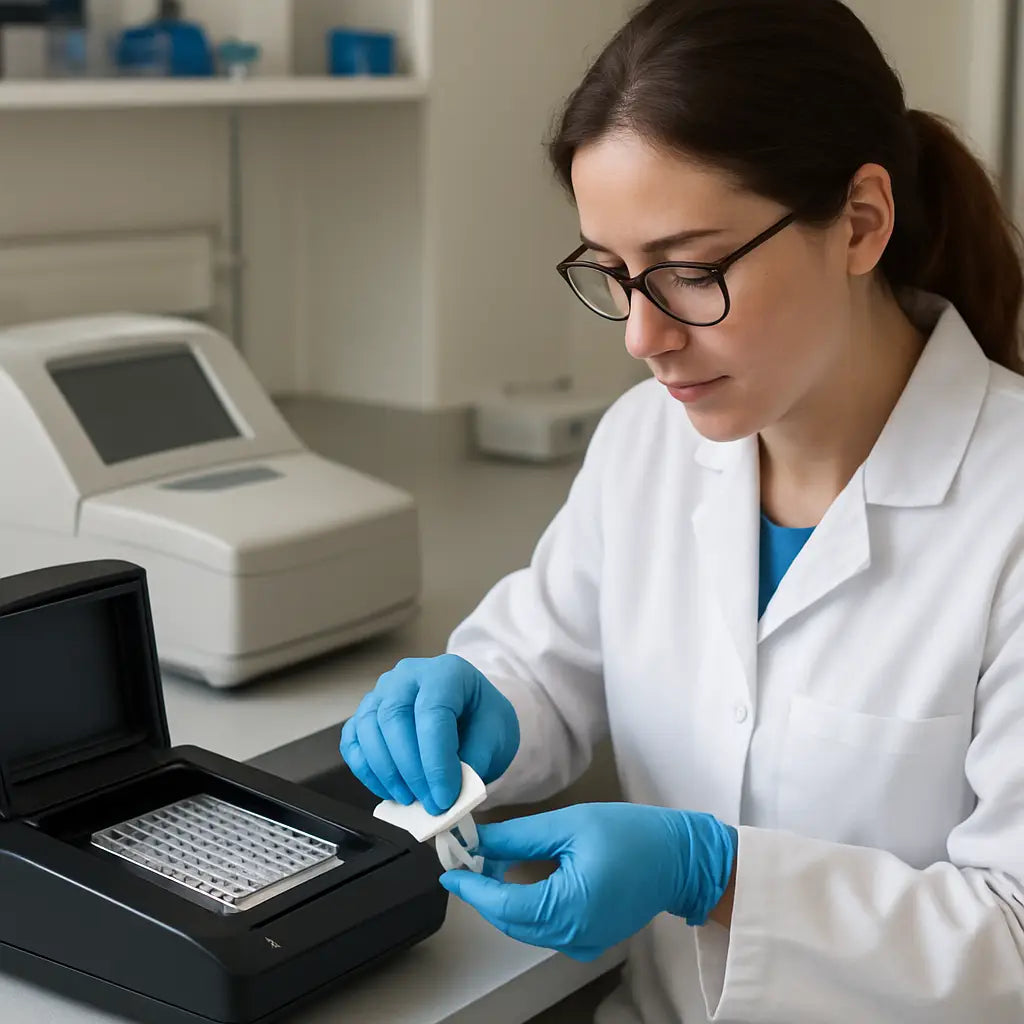
With cuvettes, make sure the walls are spotless. A fingerprint can add 0.02 absorbance units – enough to tip a borderline result over the line. Use lint‑free wipes and, if possible, a quick ethanol rinse before each run.
3. Keep an eye on temperature and timing
Both instruments are temperature‑sensitive. A 2 °C shift can change absorbance by a few percent. If your lab doesn’t have a climate‑controlled room, let the instrument warm up for at least 10 minutes and keep samples on ice until you’re ready to read.
Timing matters too. Fluorescence can fade quickly, so capture the read within the recommended window – usually under a minute after mixing. For absorbance, let the reaction settle for a few seconds to avoid bubbles skewing the signal.
4. Perform data sanity checks before you move on
Look for outliers that don’t fit the standard curve. In a plate reader, a well that spikes high or low often signals a pipetting slip or edge effect. In a spectrophotometer, a sudden jump in absorbance across runs may hint at lamp aging.
One trick we love is to duplicate a control well in each row (or duplicate a cuvette measurement). If those duplicates differ by more than 5 %, pause and troubleshoot before you trust the whole dataset.
5. Document everything, even the little stuff
Write down the lot number of the plate, the exact pipette tips used, and the ambient humidity. Future you will thank present you when a subtle change in a reagent batch throws off a critical experiment.
Finally, remember the microplate reader vs spectrophotometer decision isn’t a one‑time choice. As your workflow evolves, revisit these tips. The goal is simple: let the instrument do the heavy lifting while you stay confident the numbers are truly yours.
FAQ
What is the main difference between a microplate reader and a spectrophotometer?
A microplate reader can measure dozens or hundreds of samples in a single scan, while a spectrophotometer reads one cuvette at a time. The reader shines light into each well of a plate and records absorbance, fluorescence or luminescence all at once. A spectrophotometer sends a single beam through a single cuvette, giving you very precise absorbance numbers but far lower throughput.
When should I choose a microplate reader for my lab?
If you routinely run ELISAs, kinetic assays, or any experiment that produces many data points, a plate reader saves you hours of pipetting and reading. It’s especially useful for CROs, biotech startups, and academic cores that process dozens of plates daily. The ability to use black, white or clear plates also reduces reagent waste, which matters when budgets are tight.
When is a spectrophotometer still the better option?
When you need the highest possible accuracy for a single sample, such as clinical hemoglobin measurements or calibration of standards, a spectrophotometer shines. Its fixed 1 cm path length and high‑quality optics give very tight absorbance values, ideal for regulatory submissions or method development. Small teaching labs that only run a few assays per week also benefit from its compact footprint and lower cost.
Can I run fluorescence assays on a spectrophotometer?
Most classic spectrophotometers handle only absorbance, so you’d need an add‑on fluorometer or a separate instrument for fluorescence. Some newer models include a fluorescence module, but they are less common and usually more expensive. If your workflow mixes absorbance and fluorescence, a multimode microplate reader lets you switch modes with a click, avoiding extra hardware.
How do I keep my data reliable with either instrument?
Start every run with a fresh blank—solvent in a well or a clean cuvette. Follow with a short standard curve that matches your assay range. Duplicate key samples and flag any duplicate that varies by more than 5 %. Record lot numbers, tip types, and ambient temperature; those details become lifesavers when results drift later.
What maintenance tasks should I schedule?
For a plate reader, clean the optics weekly, check the plate lid for scratches, and run a quick calibration with a known standard. Spectrophotometers need lamp replacement every 6‑12 months and occasional wavelength verification with a certified filter. Both instruments benefit from regular software updates and a tidy bench space to avoid dust buildup.
Is it worth buying both instruments?
Many labs start with a spectrophotometer for method development, then add a plate reader as sample volume grows. If you have room and budget, owning both gives you flexibility: precise single‑sample work when you need it, and high‑throughput runs when you don’t. Assess your daily sample count, assay types, and space constraints to decide which combination makes sense now and in the future.
Conclusion
After walking through the microplate reader vs spectrophotometer debate, the picture becomes clearer: choose the tool that matches your daily workflow, not the hype.
What matters most?
If you’re pumping out dozens of ELISAs, kinetic screens, or environmental assays every day, the plate reader’s speed and multi‑mode flexibility will save you hours and reagents. If you need razor‑sharp absorbance accuracy for clinical validation or method development, a spectrophotometer’s single‑beam precision still wins.
Think about your bench space, budget ceiling, and future growth. A compact spectrophotometer fits a teaching lab or a small startup, while a larger plate reader pays off as sample volume climbs.
Next steps
Make a quick inventory: count samples per week, list assay types, and note any fluorescence or luminescence needs. Plot those numbers against the comparison table you just read, and you’ll see which side of the microplate reader vs spectrophotometer line you land on.
When you’re ready to act, platforms like Shop Genomics make ordering and support straightforward, so you can get the instrument up and running without a headache.
Bottom line: the right instrument becomes an extension of your science, letting you focus on discovery instead of juggling hardware. Choose wisely, calibrate regularly, and let the data speak for itself.