

Most American laboratories face a major hurdle when it comes to producing reliable, repeatable data. In fact, studies reveal that nearly 50 percent of scientific experiments struggle with reproducibility, impacting research credibility and funding. Standardized laboratory workflows have become critical for any American research team aiming for precision and consistent quality. Discover how adopting systematic procedures can transform chaotic experiments into dependable, efficient scientific progress.
Table of Contents
- Defining Standardized Laboratory Workflows
- Key Benefits of Workflow Standardization
- Best Practices for Standard Operating Procedures
- Impact on Data Quality and Reproducibility
- Common Challenges and How to Overcome Them
Key Takeaways
| Point | Details |
|---|---|
| Standardized Workflows Improve Efficiency | Implementing standardized workflows reduces variability, enhances reproducibility, and allows researchers to focus on innovative exploration. |
| Automation Enhances Precision | Laboratory automation minimizes human error and supports the scalability and adaptability of research protocols. |
| SOPs Ensure Consistency | Well-crafted Standard Operating Procedures provide clear guidelines that enhance training, reduce ambiguity, and maintain research integrity across teams. |
| Overcoming Challenges is Key | Addressing organizational resistance and integrating technology strategically are essential for successfully standardizing laboratory workflows. |
Defining Standardized Laboratory Workflows
Standardized laboratory workflows represent a systematic approach to conducting scientific research and experiments with precision, reproducibility, and efficiency. At its core, a standardized workflow is a predefined, methodical sequence of procedures designed to minimize variability and ensure consistent results across different research contexts. These workflows transform scientific protocols from variable individual practices into structured, repeatable processes that can be systematically implemented and validated.
The fundamental components of a standardized workflow include detailed documentation of each step, precise measurement protocols, consistent equipment usage, and well-defined quality control mechanisms. Laboratory workflow optimization techniques help researchers establish clear guidelines that reduce human error, enhance data reliability, and streamline research processes. By creating comprehensive standard operating procedures (SOPs), laboratories can ensure that every team member follows identical methodological approaches, regardless of individual skill levels or prior experience.
Modern scientific research increasingly relies on laboratory automation to support standardization efforts. Advanced technologies enable researchers to minimize human intervention while maintaining exceptional precision. These automation systems range from robotic sample handling to computer-controlled measurement platforms, each designed to introduce consistent performance across experimental trials. Key benefits include reduced human error, increased experimental reproducibility, and the ability to handle complex, multi-step protocols with remarkable accuracy. Laboratories adopting these technologies can significantly enhance their research capabilities by creating workflow models that are not just standardized, but also scalable and adaptable to emerging scientific challenges.
Implementing standardized workflows requires a strategic approach that involves several critical steps:
- Comprehensive documentation of existing procedures
- Identifying potential sources of variability
- Developing clear, step-by-step protocols
- Training personnel on standardized methods
- Continuous monitoring and refinement of workflow processes
- Integrating quality control checkpoints
By embracing these principles, research teams can transform their laboratories into highly efficient, reliable scientific environments that consistently produce high-quality, reproducible results.
Key Benefits of Workflow Standardization
Workflow standardization delivers transformative advantages that extend far beyond simple process documentation, fundamentally reshaping how scientific research is conducted. Operational efficiency emerges as the primary benefit, enabling research teams to streamline complex procedures, reduce redundant activities, and allocate resources more strategically. By establishing consistent methodological frameworks, laboratories can dramatically minimize time spent on repetitive administrative tasks and redirect that energy toward innovative scientific exploration.
The most significant impact of workflow standardization lies in its ability to enhance research reproducibility and data quality. Practical examples of lab automation demonstrate how standardized protocols create a systematic approach that minimizes human error and ensures consistent experimental conditions. When every team member follows identical procedures, the likelihood of variability decreases substantially, resulting in more reliable scientific outcomes. This consistency becomes crucial in fields requiring precise measurements, complex experimental designs, or collaborative international research projects where methodology must be transparently communicated and replicated.

Financial and operational benefits of workflow standardization extend across multiple organizational dimensions. Laboratories implementing comprehensive standardization strategies can expect significant cost reductions through optimized resource allocation, reduced waste, and improved personnel training efficiency. These standardized workflows facilitate smoother knowledge transfer, enable faster onboarding of new researchers, and create a structured environment where scientific protocols can be quickly understood and implemented. Moreover, standardization supports better compliance with regulatory requirements, reduces potential legal risks, and establishes a culture of precision and accountability.
Key benefits of workflow standardization include:
- Enhanced research reproducibility
- Reduced experimental variability
- Improved data quality and reliability
- Faster knowledge transfer between team members
- Simplified training and onboarding processes
- Better resource allocation and cost management
- Increased operational transparency
- Stronger regulatory compliance
By embracing workflow standardization, research organizations can transform their scientific processes from inconsistent practices into robust, reliable, and efficient systems that drive innovation and scientific discovery.
Best Practices for Standard Operating Procedures
Standard operating procedures (SOPs) represent the foundational blueprint for consistent scientific research, providing comprehensive guidelines that transform complex experimental processes into structured, repeatable workflows. Effective SOP development requires a meticulous approach that balances technical precision with clarity, ensuring that researchers at all experience levels can understand and implement procedures with minimal ambiguity. By creating robust documentation, laboratories establish a critical framework for maintaining research integrity, reducing human error, and facilitating knowledge transfer across teams and research generations.
Small lab essentials and tools highlight the importance of creating SOPs that are not just comprehensive, but also adaptable and user-friendly. The most successful standard operating procedures incorporate visual elements like flowcharts, detailed step-by-step instructions, and clear documentation of potential variations or troubleshooting strategies. Implementing version control mechanisms ensures that SOPs remain dynamic documents that can be continuously refined based on emerging research techniques, technological advancements, and team feedback.
Modern SOP development extends beyond traditional documentation, leveraging digital platforms and collaborative technologies to enhance transparency and reproducibility. Researchers are increasingly utilizing version control systems and collaborative platforms to create living documents that can be simultaneously reviewed, updated, and shared across global research networks. This approach transforms SOPs from static instructions into dynamic knowledge repositories that support continuous improvement and scientific innovation. Critical elements of contemporary SOP design include comprehensive risk assessment, clear delineation of required equipment and materials, precise measurement protocols, and explicit safety guidelines.
Key components for developing robust standard operating procedures include:
- Precise, unambiguous language
- Comprehensive step-by-step instructions
- Clear equipment and material specifications
- Safety and risk mitigation guidelines
- Troubleshooting and error prevention strategies
- Version control and update mechanisms
- Visual aids and supplementary documentation
- Accessibility across different skill levels
By implementing these best practices, research organizations can create standard operating procedures that not only standardize scientific workflows but also foster a culture of precision, collaboration, and continuous scientific advancement.
Impact on Data Quality and Reproducibility
Standardized workflows represent a critical breakthrough in scientific research, fundamentally transforming how data quality and reproducibility are approached and maintained. Research integrity hinges on the ability to consistently replicate experimental results, and standardized protocols provide the essential framework for achieving this fundamental scientific objective. By eliminating individual variations and establishing precise, documented methodological approaches, laboratories can create a robust environment where experimental outcomes can be verified, validated, and confidently reported.
Laboratory workflow optimization techniques demonstrate that systematic procedural standardization directly correlates with improved data reliability. When researchers follow identical protocols with meticulously defined parameters, the potential for human error diminishes dramatically. This reduction in variability means that experimental results become more predictable, comparable, and trustworthy across different research teams, institutions, and even international collaborations. The implications extend beyond individual experiments, contributing to a more transparent and accountable scientific ecosystem where knowledge can be confidently built upon previous research foundations.
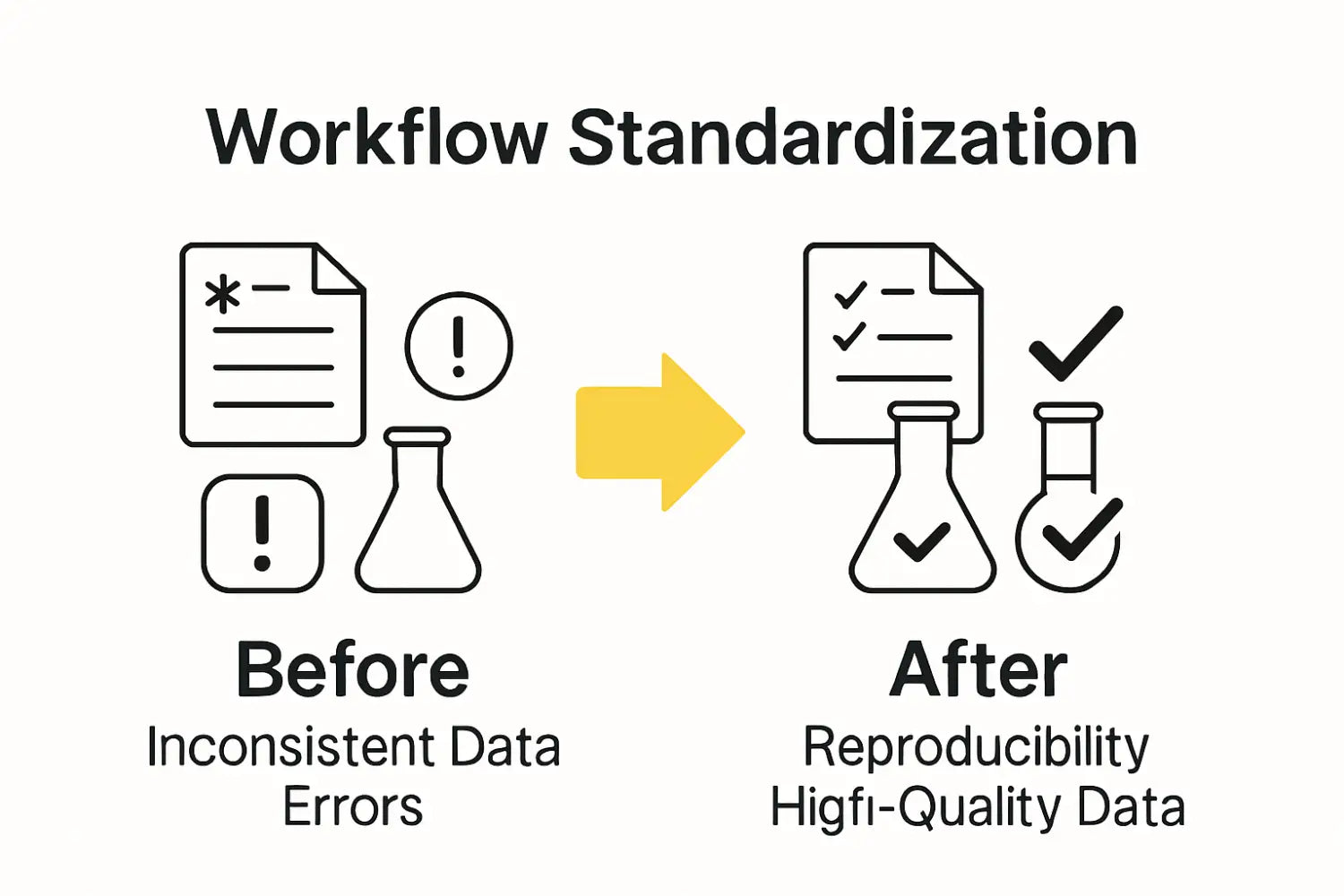
Modern scientific disciplines increasingly recognize standardization as a critical mechanism for enhancing research credibility. Advanced technologies and collaborative platforms now enable researchers to document, share, and verify experimental protocols with unprecedented precision. These systems create dynamic, interconnected research environments where methodological transparency becomes the norm rather than the exception. Comprehensive documentation, version control, and clear procedural guidelines ensure that every experimental step can be traced, understood, and potentially replicated by other researchers, thus strengthening the collective scientific knowledge base.
Key impacts of standardized workflows on data quality include:
- Minimized experimental variability
- Enhanced result reproducibility
- Increased research transparency
- Improved inter-laboratory comparisons
- Reduced human error potential
- More efficient knowledge transfer
- Stronger foundation for meta-analyses
- Better compliance with scientific publication standards
By embracing rigorous standardization, research organizations can transform their approach to data generation, creating a more reliable, efficient, and trustworthy scientific research ecosystem that accelerates global knowledge advancement.
Common Challenges and How to Overcome Them
Standardizing laboratory workflows presents a complex array of challenges that require strategic, multifaceted approaches to successfully implement and maintain. Organizational resistance emerges as the primary obstacle, with many research teams struggling to transition from established individual practices to systematic, standardized methodologies. This resistance often stems from deeply ingrained work habits, personal scientific autonomy, and a natural hesitation to adopt new procedural frameworks that might initially seem restrictive or time-consuming.
Practical examples of lab automation reveal that technological integration represents another significant challenge in workflow standardization. Laboratories must carefully navigate the complex landscape of selecting appropriate automation technologies, training personnel, and ensuring seamless integration with existing research infrastructure. Successful implementation requires a holistic approach that balances technological capabilities with human expertise, creating adaptive systems that enhance rather than replace scientific creativity and critical thinking.
Technical complexity and resource constraints further complicate workflow standardization efforts. Smaller research organizations often face significant barriers related to financial investments, personnel training, and technological infrastructure. Modern laboratories must develop nuanced strategies that allow for incremental implementation, focusing on modular approaches that can be scaled and adapted over time. Workflow management software and collaborative platforms have emerged as critical tools in addressing these challenges, providing flexible solutions that can accommodate diverse research environments and evolving scientific methodologies.
Key strategies for overcoming standardization challenges include:
- Comprehensive team engagement and communication
- Gradual, phased implementation approaches
- Continuous training and skill development
- Flexible technological solutions
- Regular performance assessment
- Incentivizing process improvement
- Developing adaptable documentation systems
- Creating culture of collaborative innovation
By anticipating potential obstacles and developing proactive mitigation strategies, research organizations can transform workflow standardization from a daunting challenge into a powerful mechanism for scientific advancement and operational excellence.
Elevate Your Laboratory Workflow with Precision and Reliability
Standardizing laboratory workflows can feel overwhelming with challenges like organizational resistance and technical complexity. This article highlights key pain points such as reducing human error, improving reproducibility, and integrating automation to create efficient, validated protocols. Achieving these goals calls for reliable equipment and accessible technology that empower your team to implement best practices seamlessly.
At Shop Genomics, we understand the importance of transforming your research environment into a hub of consistent and reproducible results. Our collection of cutting-edge research instruments and affordable solutions helps you overcome barriers to standardization, from precise measurement tools to automation-friendly devices. Discover how our resources support your mission to enhance data quality while optimizing workflow efficiency.
Unlock the full potential of your laboratory today by exploring Shop Genomics, your partner in scientific advancement. See how practical tools make workflow standardization achievable with practical examples of lab automation and master efficiency through laboratory workflow optimization techniques.
Take the next step in your research journey and empower your team with technology designed for precision, reproducibility, and growth.

Frequently Asked Questions
What are standardized laboratory workflows?
Standardized laboratory workflows are systematic approaches designed to minimize variability in scientific research, ensuring consistent results through predefined procedures. These workflows establish repeatable processes that can be implemented and validated across various research contexts.
Why is standardization important in laboratory research?
Standardization enhances research reproducibility, improves data quality, minimizes human error, and increases operational efficiency. By following identical protocols, laboratories can produce reliable results and simplify training and knowledge transfer among team members.
How can automation improve laboratory workflow standardization?
Laboratory automation minimizes human intervention, ensuring precision and consistency in experimental procedures. Automated systems, such as robotic sample handling and computer-controlled measurements, help labs scale their workflows while maintaining accuracy across complex protocols.
What are key components of an effective standard operating procedure (SOP)?
An effective SOP includes precise language, comprehensive instructions, clear specifications for equipment and materials, safety guidelines, troubleshooting strategies, version control, and visual aids. This ensures that procedures are easily understood and can be followed by researchers at various skill levels.
Recommended
- Laboratory Workflow Optimization: Boost Efficiency Step-by-Step – Shop Genomics
- 7 Essentials for Small Labs: Tools and Tips for Success – Shop Genomics
- How to Set Up Lab Equipment for Accurate Results – Shop Genomics
- How to Select Lab Equipment for Accurate Results – Shop Genomics
- Streamline Your Inventory Management Workflow for Growth | Reddog Consulting Group
- Clean Labelling’s Role in Production & Procurement